
DLG GROUP · HVAC / DOMESTIC HOT WATER & SOLAR TIMING
Heat-pump water heaters: plan the water, air and electricity.
Read the hot-water proposal as a coordinated air, water, electricity and drainage system. Compare household draw patterns, equipment location and operating modes before tank volume alone.
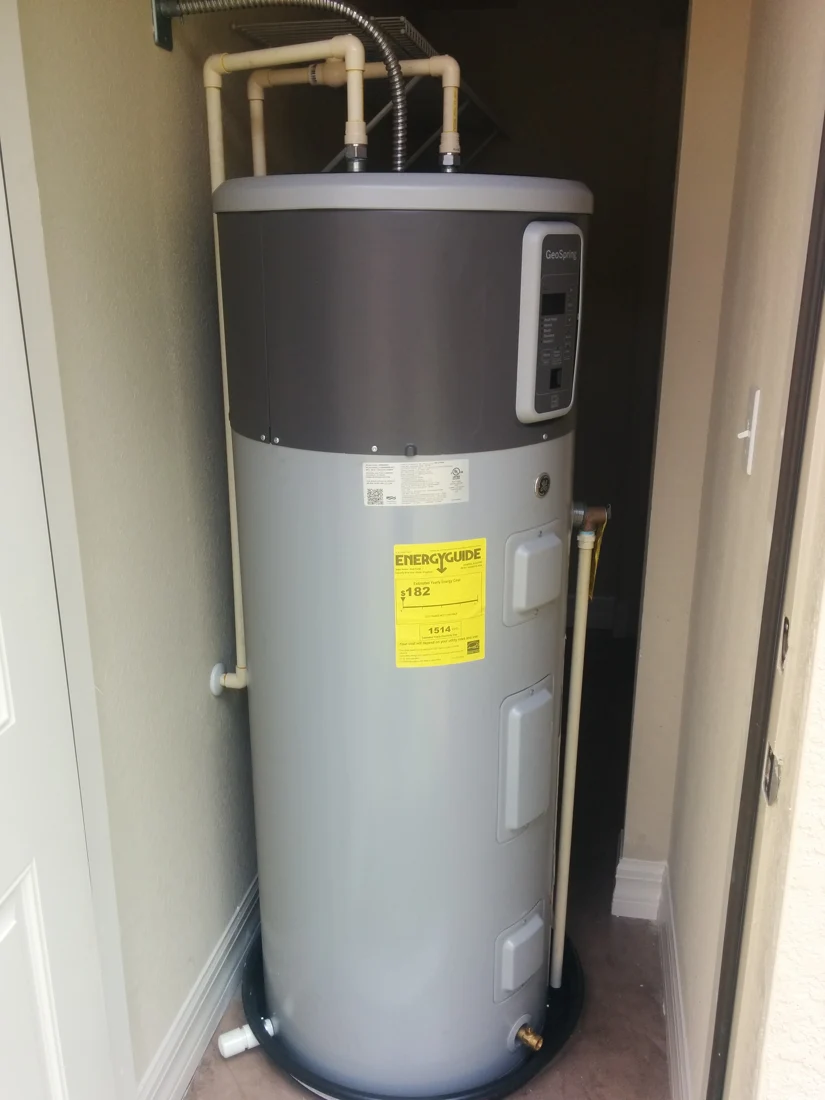
ACTUAL PHOTOGRAPH / REFERENCE
The water heater and the room work together
- Top pipework: Water connections are visible above the cabinet; use the piping diagram to identify each line.
- Front controls: The control panel is visible on the upper front of the unit.
- Front access panels: Check the manufacturer’s service instructions and how much working room the installation provides.
Verify on site: Verify the air inlet and discharge routes, the condensate destination, and the exact model’s clearance. Those details are not established by this photograph. See the concept diagram.
This source photograph shows a heat-pump water heater with top pipe connections, front access panels and adjacent room surfaces. It is a visible-equipment reference: the air route, drainage, service clearances and operating performance need their own evidence. The photographed EnergyGuide label is historical, not a current cost estimate.
Ask: Which dimensions, room-air conditions, connection diagram and maintenance access are documented for the exact proposed model?
Photo source & use
Sunroc Builders · Courtesy of the U.S. Department of Energy. BASC image record · BASC reuse guidance. EXIF orientation, resized and WebP encoded; no crop or retouching. Source and reuse guidance checked 27 October 2026. Not a DLG installation, current product recommendation or approval of the pictured arrangement.
01 / Equipment, room & connections
A hot-water tank is part of a larger system: the household's draw pattern, the room supplying heat, plumbing, drainage, electrical capacity and operating controls. Read the proposal as that complete scope rather than as a tank size and an efficiency label.
1. Identify what is heating the water
ENERGY STAR describes a heat-pump water heater as moving heat from surrounding air into stored water using electricity. Many hybrid models also have electric-resistance heating; operating-mode names and the availability of timer/vacation functions vary. Ask which mode the quoted performance and capacity refer to. [W01]
| Arrangement | What to identify | Keep separate |
|---|---|---|
| Integrated HPWH | Heat-pump assembly and domestic-water tank in one appliance; exact model and permitted air arrangement. | The room supplying heat and the electrical circuit remain part of the installation. |
| Split or combined system | Outdoor/indoor equipment, domestic-water arrangement and each component's role. | A space-heating buffer vessel is not automatically a potable hot-water tank. |
| Solar PV + HPWH | PV supplies electricity through the home's electrical system; the HPWH transfers heat. | PV panels do not connect to the tank as hot-water pipes. |
| Solar thermal | Collector, heat-transfer circuit, storage and any backup arrangement. | This is a different system from the PV scheduling exercise below. |
This guide focuses on an integrated domestic HPWH. A combined air-to-water heating design requires its own hydraulic and potable-water design; a product described as a heat pump should not be assumed to perform both jobs. Continue with solar + heat-pump integration for the broader electrical/thermal roles.
2. Review the location before accepting the price
Check the room before choosing the tank
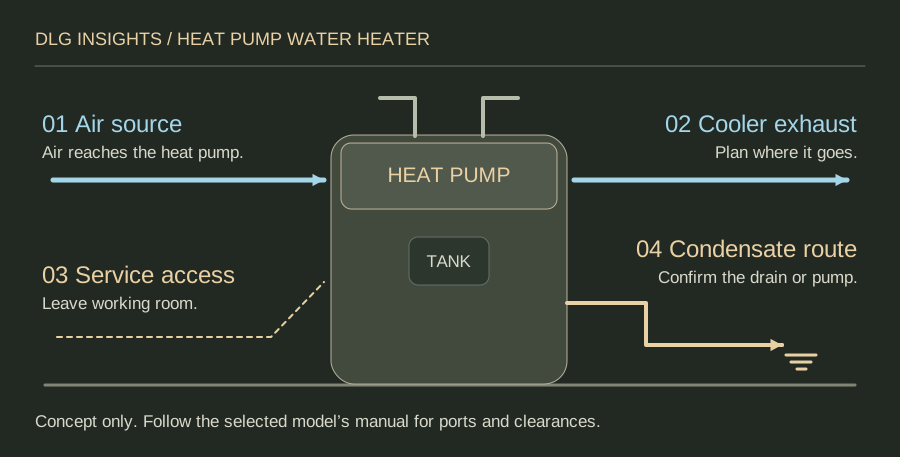
Air: A heat pump water heater draws heat from nearby air and discharges cooler air. If the unit is in a closet, verify the air path and any model-specific ventilation provisions.
Water and access: Identify the condensate destination and show how the filter and service panels can be reached. Ask where noise and cooler exhaust will be felt, especially beside a frequently used room.
See what to ask for in the proposal · How shower drain-water heat recovery differs
PNNL identifies the available heat in the surrounding air as a thermal resource. An integrated HPWH cools that air as it extracts heat and also produces condensate and sound. The room, air route and occupants' comfort therefore matter alongside physical fit. [W02]
- Measure the complete service space: record appliance height, access route, overhead fittings and access to the filter, controls and replaceable parts. ENERGY STAR's design guide treats space and air availability as selection issues. [W03]
- Identify the heat source: mark whether the room is conditioned, unconditioned or connected to another space. Ask how the operating air-temperature range and any permitted ducting are checked for this model.
- Review comfort: ask where cool discharge air and equipment sound will be experienced, including during the proposed midday or overnight operation.
- Plan drainage and electrical work: request the route and responsibility for condensate, leak management and the model's electrical requirements. DOE's decision guidance treats these as installation questions rather than a universal tank-replacement recipe. [W04]
Our planning inference: if heat is taken from a heated room in winter, assess the interaction with the home's space-heating demand; do not count that heat as cost-free in a whole-home estimate. In warm conditions the cooling effect may be useful, but it is not a promise of room air conditioning or humidity control. An HPWH does not establish an outdoor-air ventilation system.
3. Separate water, heat, electricity and drainage
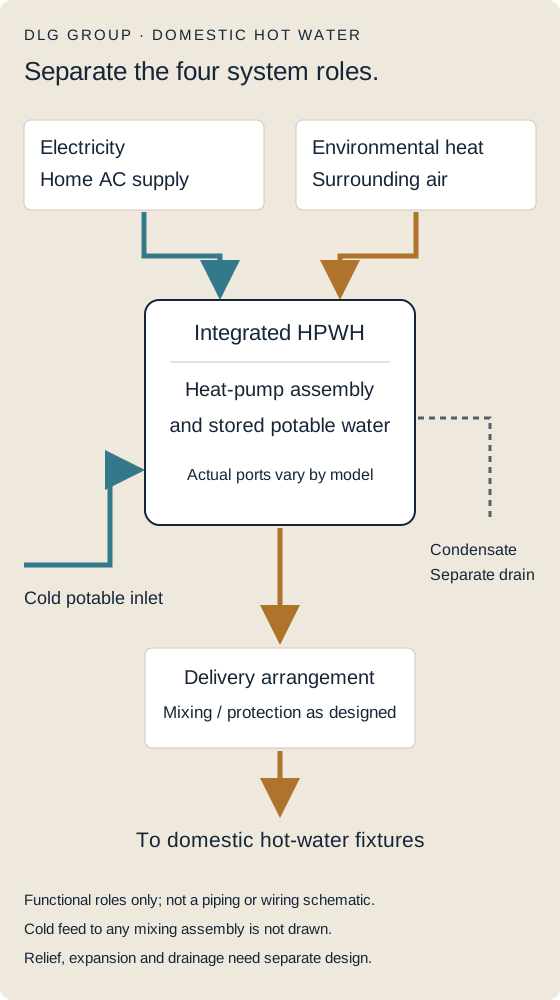
ENERGY STAR's installation guidance discusses accessible controls, clear air paths, service access and a thermostatic mixing valve that combines hot and cold water to regulate delivery temperature. The installed arrangement and settings need to be agreed for the actual home. [W05]
Ask the installer to provide a marked connection drawing: potable cold inlet, hot outlet and any mixing assembly; separate condensate route; leak-pan/overflow provisions where applicable; pressure/temperature relief and thermal-expansion provisions; isolations and service access; and electrical/control connections. The diagram above deliberately does not route safety discharges or approve a shared drain.
Keep drinking-water plumbing separate from rainwater collection, appliance condensate and any space-heating circuit unless a qualified design explicitly provides an approved separation arrangement. Ask who checks the plumbing, electrical and local permit scope. Refer to the renovation permits and sequence guide for application preparation.
02 / Demand, calculation & solar timing
4. Read the draw pattern, not just tank volume
PNNL distinguishes First Hour Rating (FHR), the hot-water supply available in the first hour starting with a heated tank, from Uniform Energy Factor (UEF), an efficiency metric. Household demand, incoming-water temperature and the operating environment can change actual performance. A tank volume alone does not establish peak delivery. [W02]
Make a household draw schedule: showers that overlap, bath fills, laundry/dishwasher use, guests and the longest acceptable recovery period. DOE's decision guidance connects water-use assessment with tank size and FHR. [W04] Ask the firm to show which demand period governs its selection and which operating mode is assumed.
ENERGY STAR publishes different efficiency criteria for integrated, lower-current integrated and split HPWH types. This illustrates why electrical configuration and product category must be identified before comparing labels. [W06] UEF is not a measured COP for a chosen hour, and neither figure is a promise of the same result in every room or schedule.
5. Follow one water-heating calculation
Illustrative bulk-water exercise
Assume 200 litres of water, approximated as 200 kg, heated through an invented 40 K temperature rise. Use a constant specific heat of 4.186 kJ/(kg·K).
Q = m × c × ΔT = 200 × 4.186 × 40 ÷ 3,600 = 9.30 kWh thermal.
At an assumed interval COP of 3.0, electricity would be 9.30 ÷ 3 = 3.10 kWh electrical, with about 6.20 kWh supplied as heat from the environment. These figures are rounded after calculation.
The 40 K rise is a mathematical input, not a recommended storage or delivery temperature. The case excludes tank/pipe losses, draws during heating, stratification, changing COP and resistance backup. It does not establish usable mixed-water volume, FHR, recovery time or appliance size.
Request a separate estimate of recovery under the selected model, room conditions and operating mode. If resistance support is used, ask how its consumption is represented. Adding tank heat to a battery's electrical kWh would combine different quantities; stored hot water cannot run electrical appliances.
6. Compare operating windows with the same job
PNNL's 2021 field-study publication examines targeted and smart load shifting with connected water heaters. It describes shifting toward periods with more renewable generation, while noting that aggressive control can challenge hot-water availability. It is evidence for a control opportunity, not a guarantee for an individual home or appliance. [W07]
Use the same rounded 3.10 kWh electrical requirement as the preceding 200-litre / 40 K / COP 3 arithmetic. For timing only, assume four equal one-hour bins of 0.775 kWh. The load shape is invented: this is not a prediction of appliance cycling, recovery or safe storage behaviour. Available PV is surplus AC electricity after other household loads. No battery or tariff is included in this four-hour comparison.
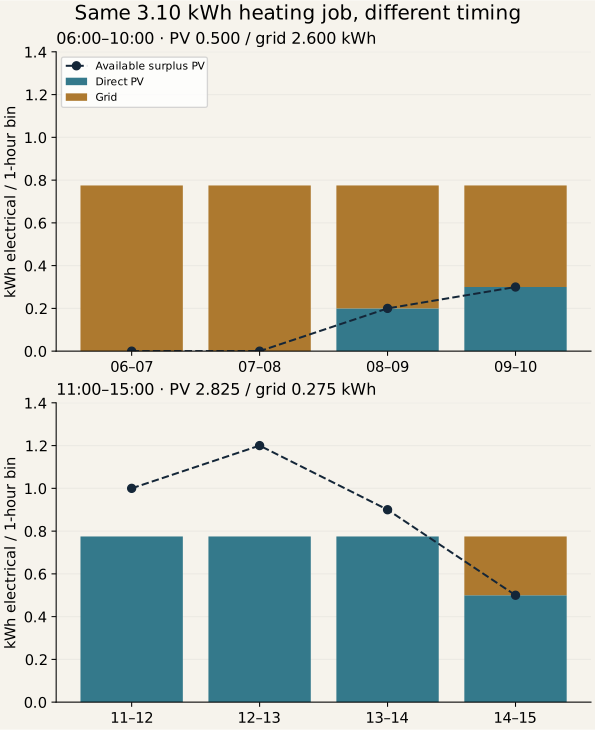
| Window | Available PV per one-hour bin | Direct PV used | Grid used | Unused surplus PV |
|---|---|---|---|---|
| 06:00–10:00 | 0.00 / 0.00 / 0.20 / 0.30 kWh | 0.500 kWh | 2.600 kWh | 0.000 kWh |
| 11:00–15:00 | 1.00 / 1.20 / 0.90 / 0.50 kWh | 2.825 kWh | 0.275 kWh | 0.775 kWh |
For each bin, direct PV is min(0.775, available surplus PV); grid use is 0.775 minus direct PV. The midday window reduces grid import by 2.325 kWh for this invented job, while total job electricity stays 3.10 kWh. Timing does not establish an efficiency gain, annual saving or payback. The wider same-day PV, water-heating and battery ledger uses this same rounded job within a separate four-bin daily profile.
03 / Controls, proposal & handover
7. Agree what the controls are allowed to do
- Meet hot-water demand first: write down the expected draw periods, reserve behaviour and recovery requirements. Tank size and schedule must be considered together.
- Separate a clock from a surplus controller: a fixed midday schedule does not measure clouds or competing loads. Ask whether live import/export data is available and whether the appliance supports the proposed control interface.
- Use supported operating controls: identify local schedule, utility programme, manufacturer app and any third-party controller. Ask which has priority and what remains functional without the internet.
- Retain the approved temperature strategy: ask the installer to document storage, delivery-temperature control and any required hygiene/protection functions. The arithmetic above is not a reason to change a setting or disable a protection.
- Document fallback: low PV, guests, lost communications and resistance-heating operation need a clear response. A PV installation does not itself establish outage power for the HPWH.
ENERGY STAR's operating-mode overview notes that timer and vacation features are not available on every model. [W01] Verify the actual controls rather than assuming an ordinary smart plug can implement the sequence.
8. Compare the complete proposal and handover
| Record | Ask the firm to show | Acceptance question |
|---|---|---|
| Demand and model | Draw schedule, FHR basis, tank/model, operating mode and recovery assumptions. | How does the highest-demand period fit the selected arrangement? |
| Location and access | Measured room/air path, model limits, sound, filter and replacement access. | Can the equipment operate and be serviced in this location? |
| Water and drainage | Marked potable-water, mixing, condensate, leak-management and protection arrangements. | Who owns each connection, test and local approval? |
| Electrical | Model-specific supply and circuit assessment, support-heater demand and included work. | Was the actual service and circuit checked? |
| Controls and solar | Supported interfaces, priority, fallback and the meaning of “solar ready”. | Is this a clock schedule, a utility signal or measured surplus control? |
| Measured handover | Operating/settings record, checks required by the manual, drain/leak checks and owner instructions. | Which results and documents will I receive? |
| Cost scope | Equipment, labour, plumbing/electrical changes, access repairs, permits, controls and removal. | Do competing totals include the same items? |
| Ongoing use | Filter/service schedule, warranty conditions, connectivity costs and responsible contacts. | Which tasks can the owner perform under the exact manual? |
DOE's FEMP purchasing guide publishes cost comparisons with explicitly stated energy-price, usage and product-year assumptions. Its federal-purchase context and example prices are not a quotation or rebate entitlement for a private home. [W08] Build a property-specific operating estimate from the selected equipment and tariff, and verify any incentive separately before treating it as a reduction in cost.
Related: building enclosure and heat-pump sizing, ventilation and heat recovery, connected-home controls and handover. The solar proposal worksheet can hold integration notes; it does not replace the HPWH demand and installation record.
Sources, assumptions and review dates
Sources and limits
Eight primary pages reviewed 21 October 2026. Original examples and figures are illustrative. This page does not specify a local code edition, temperatures, minimum room volume, pipe/circuit size, approved drain connection, product recommendation or guaranteed saving. Follow the actual model's documentation and the locally applicable design/approval process.
- ENERGY STAR: How HPWHs work. Heat transfer and operating modes.
- PNNL: HPWHs for single-family homes. Thermal resource, location and FHR/UEF roles.
- ENERGY STAR: Design considerations. Space and design review.
- DOE Building Science Education: HPWH decision guidance. Demand, electrical/plumbing and condensate coordination.
- ENERGY STAR: Installation best practices. Access, air paths and delivery-temperature control.
- ENERGY STAR: Water-heater product criteria. Product categories and rating criteria; not a local installation code.
- PNNL: Targeted and smart HPWH load shifting (2021 field-study publication). Opportunity and demand constraints; not a product guarantee.
- DOE FEMP: Purchasing efficient residential water heaters (guidance updated May 2024). Explicit economic assumptions and federal context.