Current budget
Ask: What do the dues include, and which costs remain the unit owner’s responsibility?
Budget check: Keep recurring dues separate from unit expenses.
Build the monthly ownership budget
DLG GROUP · BUYER FOUNDATIONS / ASSOCIATION DOCUMENTS
Start with three records: the current budget, recent board meeting minutes and the latest reserve study if available. Ask for the status, amount and timing of any special assessment, then see how that expense can change a buyer’s first-year condo budget.
Use this first pass to identify the questions to take to your transaction team. It is a starting point, not a complete document package or a lender approval.
Ask: What do the dues include, and which costs remain the unit owner’s responsibility?
Budget check: Keep recurring dues separate from unit expenses.
Build the monthly ownership budgetAsk: Which works or assessments are proposed or approved, when would payment be due, and who would pay?
Budget check: Record a confirmed buyer-paid amount and its timing separately.
See how an assessment changes first-year cashAsk: What major work is anticipated, when was the study prepared, and what has changed?
Budget check: A reserve balance alone does not establish whether future works are funded.
Read the funding exampleDownload the HOA document review checklist (CSV)
The worksheet has seven document topics and columns for status, document date/reference, follow-up person and notes. Open it in a spreadsheet app and keep your working copy on your device. It is not uploaded to DLG. Avoid identity numbers, account details or confidential client records.
Fannie Mae's project guide treats project finances, condition, governance and insurance as risks distinct from the borrower's own credit. Its examples of review records include declarations, budgets, reserve studies and insurance information. [H01] Ask for a dated package for the actual association and unit, not just a brochure or a previous owner's fee figure.
| Document | What to investigate | Useful follow-up |
|---|---|---|
| Declaration / master deed and plans | Unit/common boundaries, interests and recorded restrictions. | Where are the roof, windows, yard, parking and storage allocated? |
| Bylaws and rules | Decision procedures, approvals, use and enforcement. | Which amendments are current and which rules affect the intended use? |
| Budget and financial statements | Operating income/expenses, reserve contributions and actual results. | Are estimates being met, and what explains material differences? |
| Reserve study / capital plan | Components, timing, cost assumptions and funding approach. | What changed after the study date? |
| Minutes and notices | Approved/proposed works, disputes and decisions. | Which proposals have become binding commitments? |
| Insurance documents | Association coverage, deductibles and responsibilities. | What individual cover and deductible exposure should the insurer explain? |
| Resale / unit-status records | Unit-specific dues, assessments and required disclosures. | What is current for this transaction and what needs updating? |
A reserve balance alone is not a funding conclusion. Ask what components it is intended to serve, the timing of spending, restrictions on use and any collection or borrowing assumptions. Keep an operating shortfall distinct from a future replacement project.
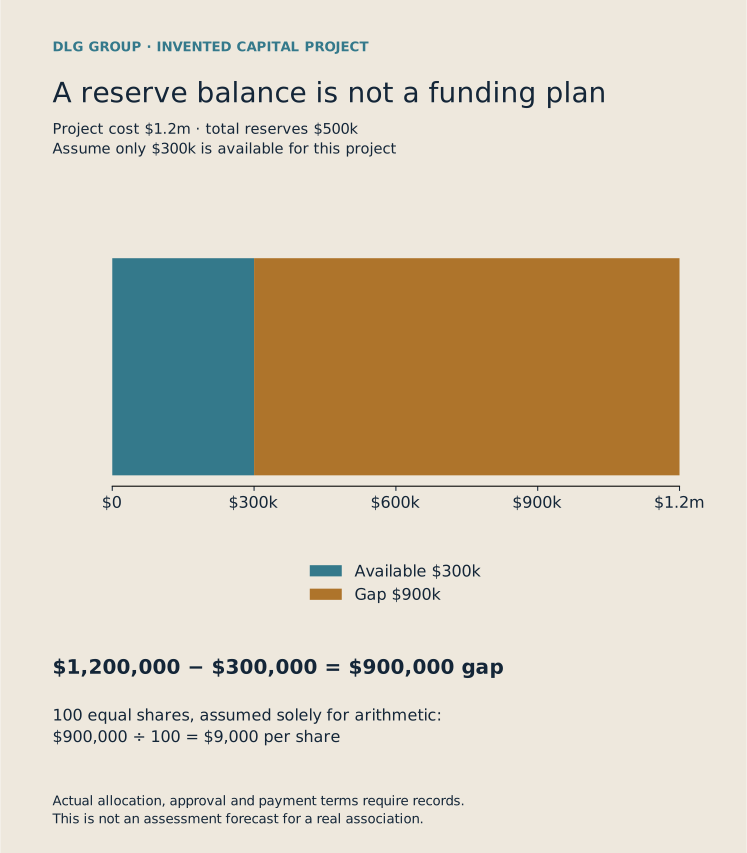
Suppose a project costs $1,200,000. Total reserves are $500,000, but only $300,000 is assumed available for this project because other obligations retain the rest. The illustrative gap is $900,000. If, solely for arithmetic, 100 units had equal shares, that would be $9,000 each. Real allocations may differ; borrowing, phasing, collections and revised costs would change the picture.
A seller's payment of a particular assessment does not answer whether later work is proposed. Ask the appropriate professional to explain which obligations are approved, proposed, payable now, transferred or otherwise allocated in the transaction. Do not infer these results from a generic checklist.
Fannie Mae's consumer guide explains that condo ownership brings shared facilities and association responsibilities. [H02] Your practical review should distinguish what you own from what you may use, alter or rent.
Record the clause and the person explaining it. “Usually allowed” and “the neighbour did it” are not substitutes for the applicable record.
Virginia DPOR publishes a standard common-interest-community resale certificate and identifies the Resale Disclosure Act as its context. The current board page is the appropriate starting point for the form, rather than an old packet copied from another purchase. [H03] [H04]
The form demonstrates that the review is broader than monthly dues. It asks for community and unit information; use it to organise questions, while the transaction's legal advisers explain applicable rights, delivery requirements and deadlines. This guide does not copy Virginia cancellation periods into Massachusetts or Georgia.
For a Massachusetts or Georgia property, obtain the locally applicable package and have its recorded instruments and contract requirements explained. A Massachusetts master deed, a Virginia resale certificate and a lender's condo questionnaire are not interchangeable simply because each concerns an association.
| Item | Evidence to attach | Who should clarify? |
|---|---|---|
| Boundary or maintenance dispute | Plan/document and relevant clause. | Appropriate legal adviser and association. |
| Funding gap or large project | Current financials, scope, study and approvals. | Association/manager with professional follow-up where needed. |
| Insurance uncertainty | Actual master-policy information and proposed owner policy. | Qualified insurance professional. |
| Financing eligibility | Requested project documents and lender response. | The lender, not a fee-comparison table. |
| Rental/alteration intention | Current restrictions and required approvals. | Association/legal/local authority as applicable. |
For a three-to-four-year hold, include upcoming works and use restrictions in the exit questions too. This is a due-diligence record, not a prediction of resale liquidity. Continue with ownership forms, the ownership budget and renovation approval preparation.
Compare the association policy with a unit policy in Condo Insurance: HOA Master Policy vs. HO‑6.
Fannie Mae references H01–H02 rechecked 20 November 2026. Virginia references H03–H04 retain the 21 October 2026 review date. No particular association, legal right, assessment or finance outcome is approved here.