
DLG GROUP · BUYER FOUNDATIONS / OWNERSHIP BUDGET
The mortgage payment is only one part of the ownership budget.
Separate mortgage payments, ownership expenses, purchase cash and future exit costs. Follow the matched example, then test how changing its assumptions changes the result.
Make one property-specific budget that separates debt service, ownership bills, operating allowances and the cash needed to buy. Keep quoted terms, public records and planning assumptions visibly different.
1. Separate the payment from the wider budget
CFPB distinguishes mortgage principal and interest from a total payment that may also include taxes, homeowners insurance and mortgage insurance. Association charges can be separate. [C01] Avoid counting a tax or insurance bill twice because it appears both in escrow and in your spreadsheet.
CFPB also explains that escrow is a payment arrangement and can change as tax and insurance costs change. [C02] A fixed interest rate does not fix every cost of owning the property.
| Layer | Use evidence from | Keep separate |
|---|---|---|
| Principal and interest | Matched lender terms and amortisation assumptions. | Loan balance, rate, term and any fees/points. |
| Taxes | Actual authority and assessment/tax records. | Existing bill versus an estimate after purchase or completion. |
| Insurance | Property-specific quotation and coverage basis. | Deductibles and excluded risks, not just annual premium. |
| Association costs | Current dues and assessment/project records. | Regular fee versus capital or special charges. |
| Maintenance and replacements | Condition report, component life and priced scope. | Routine work, known repairs and a capital allowance. |
| Rental operations | Allowed use, rent evidence and management terms. | Vacancy, management and turnover assumptions. |
2. Follow a matched financing example
Assume a $400,000 purchase, 30% down ($120,000), a $280,000 loan, a constant 6.00% annual nominal rate and 30 years of monthly amortisation. Principal and interest are approximately $1,678.74/month. This is a mathematical case, not a lender offer or an assertion of eligibility.
The formula uses monthly rate r = 0.06/12 and n = 360: payment = loan × r / (1 − (1 + r)−n). A zero-rate case is loan ÷ n. Principal repayment is a cash outflow even though it also reduces the balance; it is not all interest expense.
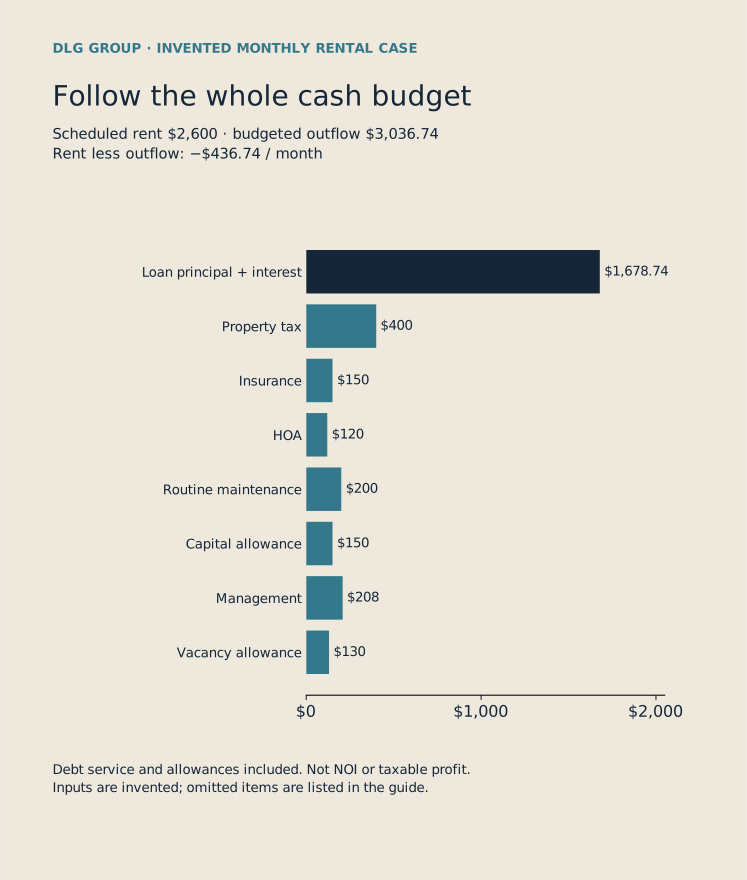
| Item | Monthly assumption | Basis |
|---|---|---|
| Principal + interest | $1,678.74 | Loan formula above. |
| Property tax | $400.00 | Invented $4,800/year. |
| Insurance | $150.00 | Invented $1,800/year; no coverage quote. |
| HOA | $120.00 | Invented fee; no special assessment. |
| Routine maintenance allowance | $200.00 | Planning allowance, not measured spending. |
| Capital replacement allowance | $150.00 | Separate from the routine allowance. |
| Management | $208.00 | Assumed 8% of scheduled $2,600 rent. |
| Vacancy allowance | $130.00 | Assumed 5% of scheduled rent. |
| Total budgeted outflow | $3,036.74 | Includes debt and both allowances. |
| Scheduled rent less outflow | −$436.74 | Before income tax and omitted items. |
3. Test what changes the conclusion
The case does not cover utilities paid by the owner, leasing/turnover charges, major unbudgeted work, special assessments, purchase/sale costs or income tax. Add them when applicable. An allowance and actual spending for the same work need consistent treatment; reserve funding is not proof that an expense occurred.
Use the same assumptions to compare properties, then replace them with evidence. Lower insurance or HOA should not be treated as an advantage before checking coverage and included services. For rent, record the source, date, concessions and whether the figure is asking or achieved.
CFPB's affordability guidance encourages a total ownership budget and notes that taxes and insurance can rise. [C03] Test a lower-rent period, a vacancy spell and a known repair rather than relying on a single positive month.
4. Keep purchase cash and exit cash separate
In a separate invented cash-to-buy exercise, $120,000 down payment plus $10,000 closing/prepaid costs plus $20,000 retained liquidity totals $150,000. The retained cash is not a closing fee. Earnest money already credited at closing must not be added again as a second purchase expense.
Compare the lender's Loan Estimate with its most recent revision; review cash to close separately from monthly principal and interest. [C04] For a three-to-four-year hold, estimate future sale costs, loan payoff, repairs/concessions and any tax effects with the appropriate professionals. Do not equate sale price minus purchase price with net investment profit.
A complete review file contains the financing assumptions, actual tax/insurance/association evidence, condition-based allowances, rent source and a list of exclusions. Continue with HOA evidence, roof/insurance review, Condo Insurance: HOA Master Policy vs. HO‑6 and closing-document roles.
Sources and scope
Checked 21 October 2026. Original invented arithmetic; no tax advice, affordability approval or return guarantee.