
DLG GROUP · BUYER FOUNDATIONS / TRANSACTION EVIDENCE
From offer to closing: keep the evidence streams separate.
Track the contract, financing, property findings and closing documents as separate workstreams. Build a transaction-specific deadline sheet and record unresolved decisions with the responsible party.
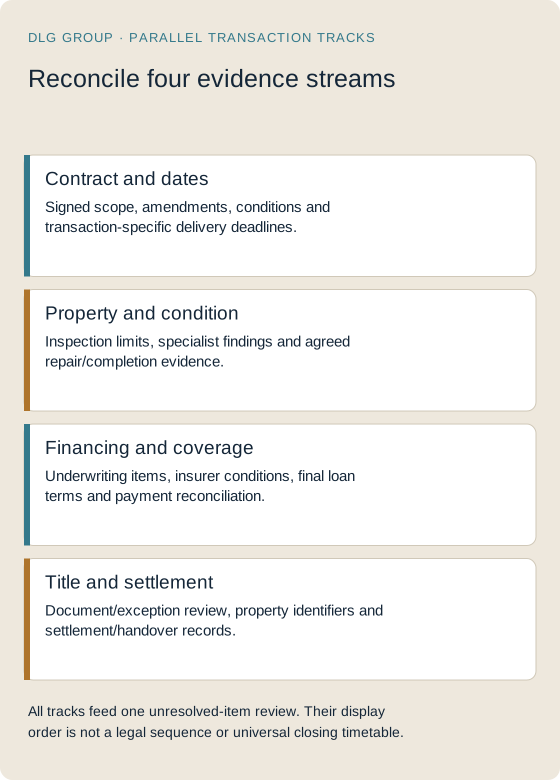
A transaction can look advanced while an essential condition remains unresolved. Track the property, the contract, the loan and the ownership records independently, then reconcile them before committing to the next step.
1. Four streams, one readiness review
CFPB's closing overview brings together underwriting requests, inspection, insurance, closing services and document review. Its process describes most mortgages, rather than every transaction. [T01] The diagram below is an original coordination tool, not a statutory order of events.
| Evidence | Question it addresses | What remains separate |
|---|---|---|
| Signed contract and amendments | What was actually agreed, by whom, with which dates and conditions? | Whether the condition has been met; ask your transaction professional. |
| Inspection and specialist reports | What was observed, inaccessible or referred for further review? | Appraised value, coverage and lender acceptance. |
| Appraisal and lender responses | What valuation or financing condition remains? | A full investigation of building condition. |
| Insurance quotation/binder and conditions | What coverage, effective date and outstanding requirements apply? | Contract remedies or title questions. |
| Title/settlement documents and exception review | Which interests, exceptions and settlement items require explanation? | A physical boundary survey or an unrestricted-use guarantee. |
| Closing Disclosure and payment reconciliation | Do final loan terms and cash figures match the understood transaction? | Completion of repairs, transfer records and possession arrangements. |
2. Build a transaction-specific deadline sheet
Request a written explanation of each applicable contract date from the professional handling the transaction. Record the clause, deadline, required delivery method, recipient, evidence of delivery and person responsible. Do not copy an inspection, cancellation or financing period from another state or a social video.
For a Massachusetts, Virginia or Georgia property, first identify the exact contract form, amendments and local closing team. Ask who addresses legal interpretation, title issues, settlement, lender conditions and recorded documents. This guide supplies a coordination framework; it does not assert one uniform MA/VA/GA closing practice or provide state-specific legal deadlines.
A useful log entry reads: “Roof evidence requested by insurer; inspector photographs received; insurer response pending; lender confirmation pending; owner of next action and applicable contract date recorded.” Avoid replacing that with a single green “inspection done” label. If a deadline is approaching while a response is missing, obtain professional guidance before treating silence as acceptance.
3. Turn findings into decisions
CFPB distinguishes a home inspection from the appraisal and advises arranging inspection early enough to address issues within the transaction. [T02] Read the report's limitations as well as its findings. An inaccessible crawlspace, unavailable equipment test or recommendation for specialist investigation is an unresolved scope item, not proof that the system is satisfactory.
- Identify the observation and the evidence behind it.
- Ask who can investigate its cause and repair scope.
- Separate the proposed repair from the agreed contractual response.
- Record any impact on insurance, financing, schedule and immediate ownership cash.
- Retain completion evidence and any remaining limitations.
Use the roof and insurance guide and building anatomy guide when coordinating these questions. A contractor quotation, a negotiated credit and a completed repair are three different records.
4. Reconcile money and documents before signing
For covered mortgages, CFPB describes receipt of the Closing Disclosure three business days before scheduled closing. Use the applicable review period to question discrepancies; confirm coverage of that requirement with the lender rather than applying it to every cash or exempt transaction. Its explainer supports checking loan terms, payment, closing costs and cash to close against the understood offer. [T03]
Make an original comparison sheet with columns for “expected,” “final document,” “difference,” “explanation” and “resolved by.” Include deposits and credits already paid, amounts due at closing, any retained liquidity and items paid separately. Do not treat the total price, total closing costs and the final additional cash required as interchangeable.
Confirm how payment instructions will be verified with your established closing contact. CFPB's closing page flags mortgage closing scams. [T01] If an instruction changes, pause the transfer and verify through an independently established contact method; a message in the same thread is not an independent check.
5. Close the record, not just the appointment
Prepare a handover folder containing the executed documents supplied to you, payment reconciliation, insurance effective-date evidence, outstanding-work log, warranties/manuals, access arrangements and the closing team's instructions for obtaining final recorded records. Confirm when possession and keys are due under the actual agreement.
Then transfer unresolved maintenance and capital items into the ownership budget. Check that the property identifier on the closing documents matches the parcel and unit evidence. Save a dated copy of the final action log rather than overwriting the history of how an issue was resolved.
Sources and scope
- T01 — CFPB closing overview; most-mortgage scope, closing tasks and scam warning.
- T02 — CFPB home inspection; limited role comparison.
- T03 — CFPB Closing Disclosure explainer; covered-loan review, not universal transaction law.
Sources checked 21 October 2026. Original document organization and questions are educational tools, not contract interpretation or legal advice for a property.