
DLG GROUP · BUYER FOUNDATIONS / ROOF, INSURANCE & FINANCE
Roof condition, insurance and the financing decision.
Build a roof condition file before comparing insurance or financing options. Keep the insurer’s terms, lender’s requirements and repair scope separate, then reconcile the open questions.
A roof can affect several decisions at once, but an inspection finding, an insurance quotation and a lender's acceptance are separate pieces of evidence. Assemble them early enough to resolve a problem before the transaction depends on an assumption.
1. Build one roof evidence file
Begin with the installation/replacement date and its evidence, materials, invoices, permits where applicable, warranties, repair history and any inspection photographs. Mark an estimated date as estimated. Ask which parts were replaced: a new covering does not by itself describe decking, flashing or concealed damage.
PNNL identifies roof valleys, wall intersections and penetrations as water-management interfaces. Use that concept to request investigation of the complete assembly rather than judging only the visible shingles. [R01] Do not climb onto the roof to fill a checklist; agree safe access and inspection limits with the professional.
| Question | Record to request | Unresolved item |
|---|---|---|
| Age and replacement scope? | Invoice, permit/completion record and material identification. | Covering only or a broader replacement? |
| Current condition? | Dated inspection, photographs and access limitations. | Which concerns require a roofer or other specialist? |
| Water entry or past repairs? | Repair history and investigation of the cause. | Was the source resolved or only the interior finish repaired? |
| Future solar work? | Roof/PV interface, removal/reinstallation and warranty responsibilities. | Who pays and who restores the roof? |
2. Read the insurance terms before reading the premium
NAIC distinguishes replacement-cost value (RCV), without depreciation deduction for the covered replacement, from actual-cash value (ACV), which deducts depreciation. The actual policy, covered cause, limits, endorsements and deductible still matter. [R02] Ask the insurer which settlement basis applies specifically to the roof, rather than assuming the label on another part of the policy answers it.
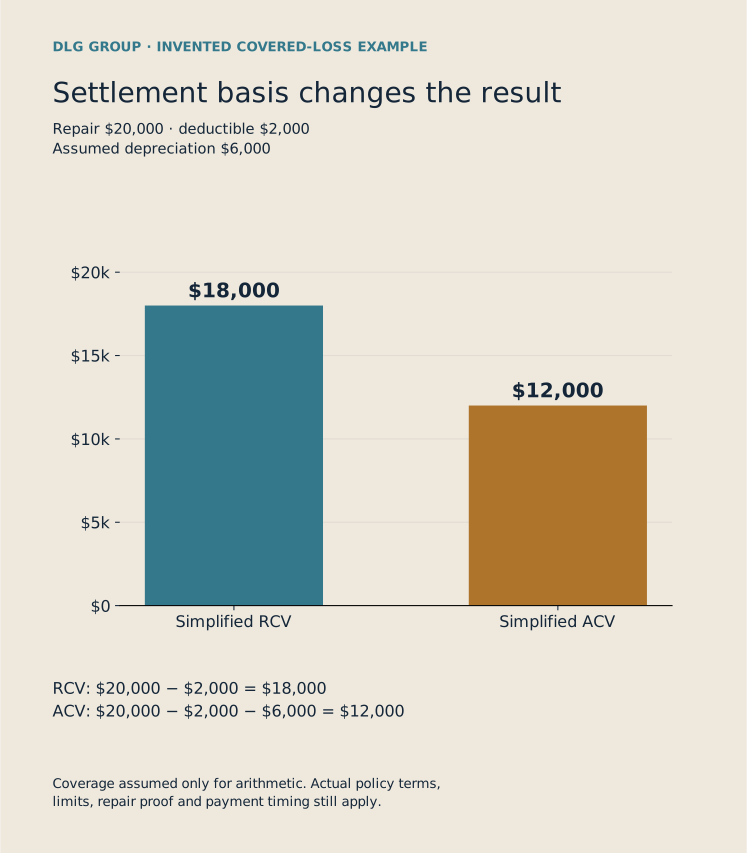
In this invented case, repair cost is $20,000, deductible $2,000 and assumed depreciation $6,000. The two simplified results are $18,000 and $12,000. The $6,000 difference does not mean every RCV policy pays it immediately or unconditionally. Ask about repair deadlines, proof of completed work, recoverable depreciation, limits and exclusions.
If a deductible is a percentage, identify its base. An invented 1% deductible applied to a $400,000 dwelling limit is $4,000, not 1% of a $20,000 repair. Do not apply that example to a policy until its actual wording and applicable deductible are confirmed.
3. Coordinate the insurer and lender
CFPB says mortgage lenders generally require evidence of homeowners insurance. It also distinguishes that property protection from mortgage insurance and explains lender-purchased insurance on an existing loan when coverage is not maintained. [R03] A purchase that needs acceptable coverage before closing and a later servicing problem are different situations.
- Provide the insurer with accurate property and roof information; record any requested inspection or repair evidence.
- Obtain the proposed coverage, exclusions, deductible, price, effective date and any conditions in writing.
- Ask the lender whether that exact arrangement satisfies its requirements and what remains outstanding.
- If repairs are needed, coordinate the contract, funding, completion evidence and revised coverage before treating the issue as resolved.
A premium estimate is not necessarily bound coverage, and a contractor's statement is not a lender approval. Record who owns each next action and the transaction deadline supplied by the relevant professional.
4. Keep regional examples in their own jurisdiction
Texas TDI's 29 September 2026 explanation distinguishes age alone from physical condition when discussing rejection or nonrenewal. It should not become a nationwide “15 years means no insurance” rule. [R04] For Massachusetts, Virginia and Georgia, obtain the actual insurer/lender position for the property and consult the applicable regulator when needed; this guide does not assert a common local age threshold.
TDI's impact-resistant roofing form records product and installation evidence and says some insurers may offer a premium discount. It does not establish a fixed annual dollar saving. [R05] Request a before/after quote on the same coverage basis, the required certification and any changed deductible or exclusion before valuing an upgrade.
5. Compare a repair or replacement proposal
Ask for removal scope, substrate assessment, water-management details, material/model, penetrations, disposal, property protection, permits and concealed-condition handling. Separate a present defect, a near-term maintenance allowance and an elective improvement. An unusually low total may simply omit an interface or repair allowance.
Before closing the file, retain the inspection, insurer response, lender response, accepted scope, completion evidence and unresolved items. Continue with ownership and responsibility, solar interfaces and the full ownership budget.
Sources and scope
- R01 — PNNL roof water management; interface concepts, no installation specification copied.
- R02 — NAIC roof ACV/RCV explanation; examples here are independently invented.
- R03 — CFPB homeowners insurance.
- R04 — TDI roof-age explanation; Texas only.
- R05 — TDI impact-resistant roofing form; no guaranteed discount.
Sources checked 21 October 2026. No policy, claim, property or credit decision is made here.