Your driving.
How much energy do you need to replace on an ordinary day? Keep everyday use separate from occasional long trips.

HOME FEATURES / ENERGY & CONNECTED SYSTEMS
Check your parking space, charging routine and home electrical setup before comparing equipment.
A U.S. homeowner’s guide · Viewing worksheet added November 1, 2026
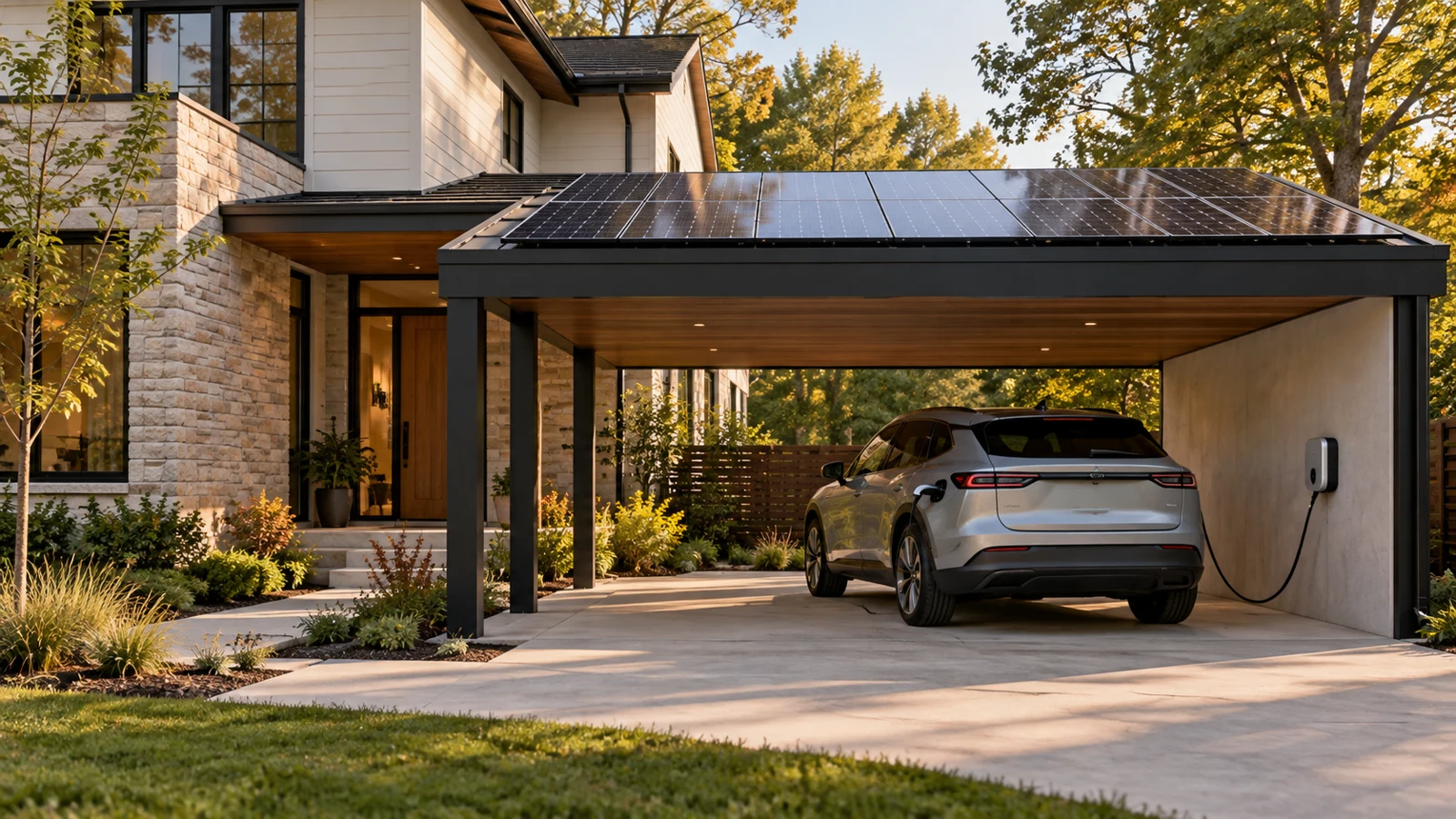
01 / START WITH THE EVERYDAY
Your daily driving, parking time and existing electrical system shape the charging conversation.
How much energy do you need to replace on an ordinary day? Keep everyday use separate from occasional long trips.
Where does the vehicle stay, and for how long? Consider cable reach, doors, walkways and access to the equipment.
Ask a qualified electrician to assess available capacity, existing loads and the proposed installation.
02 / A PLACE FOR THE CHARGER
Physical location is one decision. Plug-in versus hardwired connection is another. Assess both for the actual home and equipment.
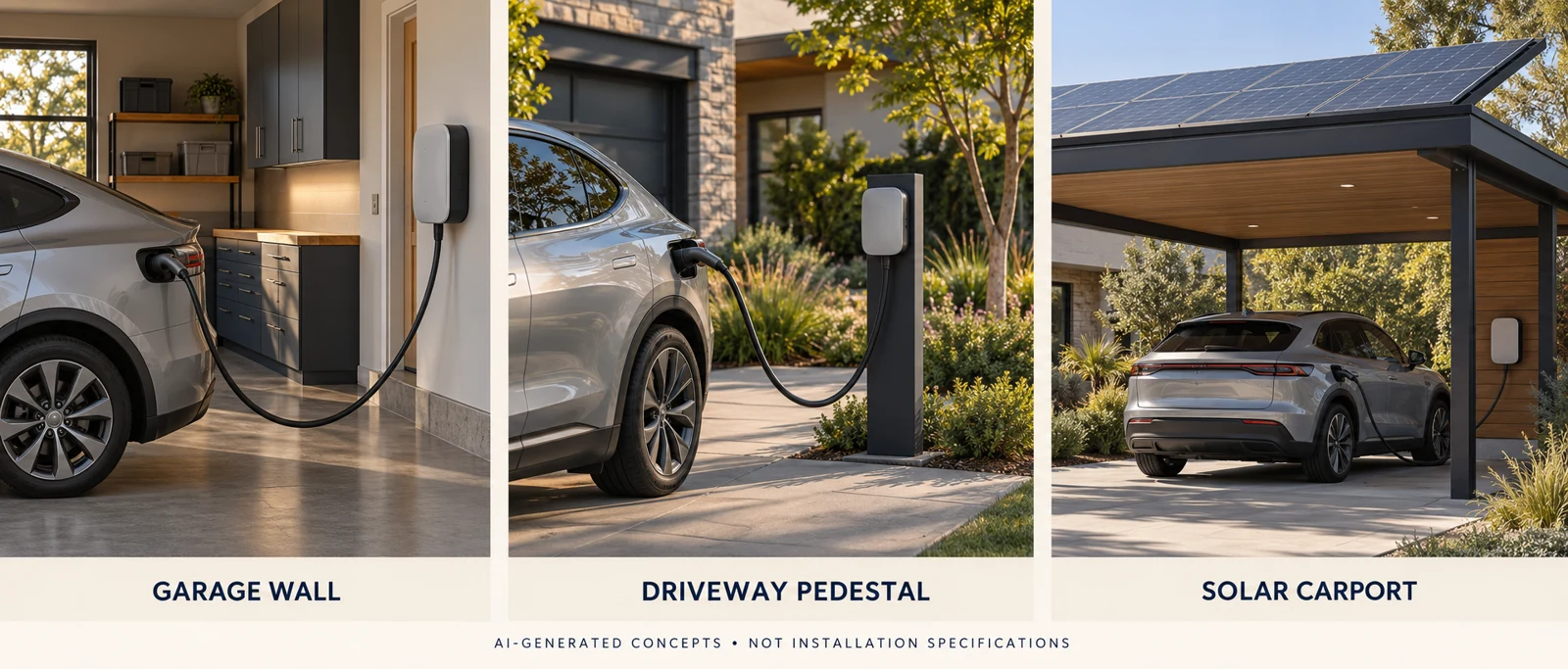
Consider parking position, wall construction, cable storage and equipment access.
Review the cable route, foundation, weather exposure and vehicle-impact protection.
Coordinate the structure, PV system and charger as distinct parts of the overall design.
03 / THINK BEYOND THE CHARGER
Solar generation, household demand and vehicle charging change through the day. The controls determine how they work together.
Explore solar & storage ↗THREE DIFFERENT CHARGING STRATEGIES
Review the charging demand alongside the home’s other electrical loads.
Choose a time window that fits your routine and applicable utility rate.
Compatible equipment and controls may adjust charging to available excess solar generation.
Solar panels alone do not establish surplus-following charging or backup capability. Confirm the complete system’s compatibility.
04 / PREPARE THE DECISION FILE
Confirm the vehicle inlet, AC charging limit, supported connector or approved adapter, and the exact charger model documentation.
Request a property-specific assessment. Include heating, cooling, hot water, existing equipment and any future second vehicle.
Separate equipment, electrical work, physical mounting, permits, inspection and utility coordination in the written proposal.
Collect manuals, equipment identification, completed-work records, warranties and account-transfer instructions.
Do not assume that a vehicle or charger can power the home. Review the complete compatible vehicle, equipment, control and interconnection arrangement.
Educational information. Confirm local requirements with the permitting authority and utility, and review the exact equipment documentation with a qualified electrician. No installation, equipment or savings recommendation is made here.
SOURCES & FURTHER READING
U.S. Department of Energy: charging at home ↗ — household charging options, electrical capacity, equipment and local approval considerations.
Tesla: Charge on Solar ↗ — one manufacturer-specific example of surplus-solar controls. The feature requires compatible Tesla vehicle, Powerwall, solar and software; it is not a feature of every charger.
Sources reviewed October 31, 2026. AI-generated images illustrate design concepts; they do not establish equipment suitability or code compliance. DLG does not certify the depicted installation.
Return to Home Features → · Solar & Storage → · Permits & records →
TAKE IT TO YOUR NEXT VIEWING
Use this twelve-point worksheet when comparing a home or preparing an installation discussion. A checked box records a question reviewed, not a safety approval or installation certification.
DLG GROUP · Home EV Charging · Viewing worksheet · November 1, 2026
Questions to follow up: _______________________________________________
____________________________________________________________________
Visual review only. Do not open electrical equipment or test an unfamiliar installation. Refer technical assessment to a qualified electrician. Confirm requirements with the local authority and utility.
Select a printer or Save as PDF in your browser’s print dialog. Tick marks are temporary until you select Save checks on this device. Each save replaces the previous copy in this browser; Restore saved checks retrieves it. No checks are sent to DLG or synced to another device. Avoid saving on shared devices. Browser data removal or private browsing may remove the saved copy. Page content draws on the guide and its linked sources; this worksheet introduces no equipment or savings recommendation.
Full guide and sources: https://dlggroupus.com/offline-review/home-ev-charging
Continue with buyer preparation → · Explore solar & storage →
Planning for an outage? Start with the circuits your home needs.