
DLG Insights / Home backup planning
What Keeps Running When the Power Goes Out?
Start with the devices you need and the hours you want them to run. Check energy for the whole outage and power when devices run together.
01 / Find the circuits that actually get backup
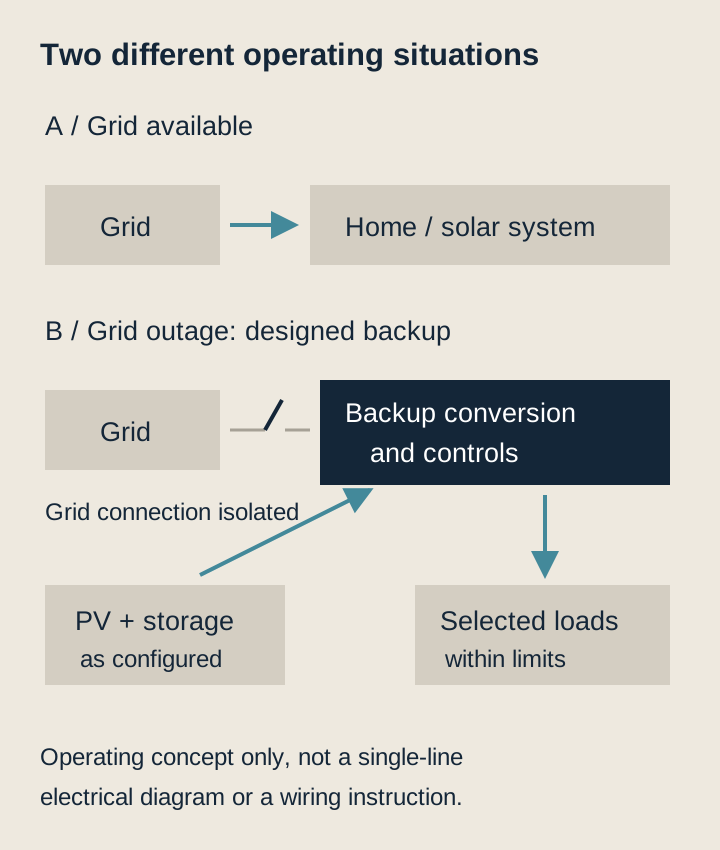
Most ordinary grid-tied solar systems shut down when the grid fails. Supplying a home during an outage requires equipment designed to isolate the backed-up system from the grid. Ask which circuits stay live and whether solar can recharge the battery during an outage.
Start with refrigeration, a lamp, communications, or a pump if it is essential. Treat EV charging and large heating or cooking loads as separate decisions. A router can have power while the internet provider is still offline.
02 / Compare energy and running power
kWh is the energy the devices use over time. kW is how much running power the inverter may need to deliver at once. Motor and compressor startup can require additional power; this worksheet does not calculate it.
Use available energy at the backed-up circuits after accounting for starting charge, reserve and losses. If you only have the battery nameplate rating, leave the available energy blank. The worksheet assumes no solar recharge. Results are energy and running-power comparisons, not a runtime or compatibility guarantee.
03 / Ask the installer to verify the limits
- Which circuits, voltages and loads can the system support in an outage?
- What continuous output and startup surge can it handle? Can it start the pump or compressor while other loads are on?
- How much energy reaches the loads at the expected starting charge? What reserve remains, and can solar restart or recharge the system off-grid?
For powered medical devices, make a separate emergency plan with your provider and device supplier. See Ready.gov outage guidance.
Sources: DOE / Rooftop solar and outages · DOE / Power and energy capacity.