
Smart Homes & Building Systems · Educational reading
A Smarter Home Starts with a Clear Plan
Choose the everyday experience first. Ask how connected systems work, fail and transfer securely to the next owner.
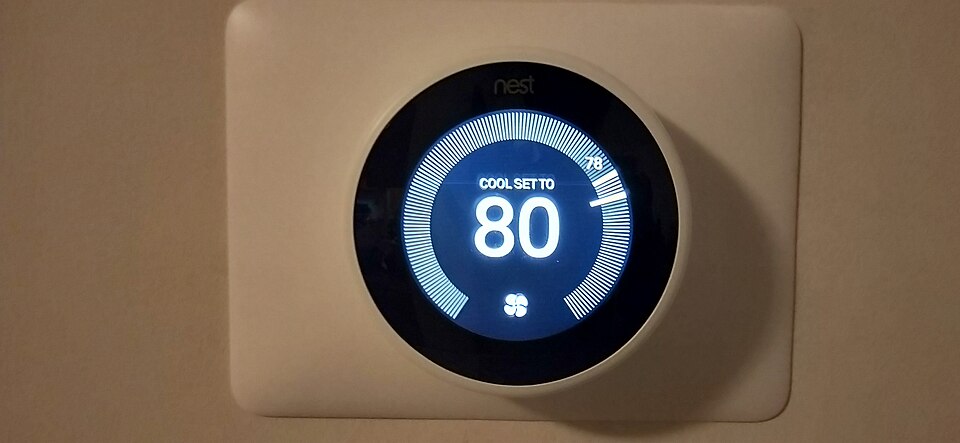
What to ask: which functions work at the device, which need a network or cloud service, and who controls the account?Photo: AG20044018 · Wikimedia Commons · CC BY-SA 4.0. No DLG image edits. Source and license checked October 16, 2026.
Choose the experience before choosing connected products.
NIST's consumer IoT baseline considers cybersecurity across the connected product. It is a framework, not certification of a particular device. [S1]
DLG perspective: start with routine use. Who operates the lights, heating controls or access system, and what needs to remain simple? Then document the exact equipment and integrations that a qualified provider must confirm.
Ask how essential functions behave when internet, a cloud service or power is unavailable. Identify manual controls, account ownership and who can remove access when residents or owners change.
Request documentation of software support, subscription conditions, collected information and maintenance responsibilities. Keep passwords and recovery credentials outside ordinary project spreadsheets.
A useful handover demonstrates routine operation, explains failure scenarios and gives the owner understandable documentation. Two products described as smart do not establish compatibility.
This guide endorses no manufacturer and promises no energy saving, security outcome or resale premium.
Educational planning only; not electrical or cybersecurity design advice.
Source register
The complete guide-set source register follows; inline IDs in the text identify the sources relevant to this article.
- M1 — National mortgage benchmark methodology, not individual quotes
- M2 — Loan Estimate fields and comparison questions
- B1 — Financing preparation before choosing a home
- I1 — Asking-rent index methodology
- R1 — Pre-1978 renovation lead-risk consumer guidance
- P1 — Consumer contractor selection and written proposals
- E1 — General roof, demand and utility considerations
- S1 — Consumer IoT cybersecurity framework
Source review retained: 9 October 2026. Public release pending.
Continue reading

A conceptual decision aid. Local control, cloud reliance and offline functions vary by product; ask the provider to demonstrate them. NIST supports account/update/privacy checks, not a specific topology.Original DLG explanatory drawing. Source context: official reading. Checked October 15, 2026.
Ask which functions operate at the device, which depend on a local network or controller and which require an account or cloud service. Record who controls access and what happens when connectivity or account access changes. The dashed arrows show possible dependencies, not a universal network topology. The figure supports a question list; it does not certify product compatibility.
Explore the details
Work through quantities, interfaces, operating limits and the evidence to request in a proposal.