
DLG Insights / Water & Drainage
When the rainwater tank fills.
Follow water from roof to tank, then trace the route it takes when there is no storage left. At a home showing, ask to see where that route ends.
Follow the roof water past the tank.
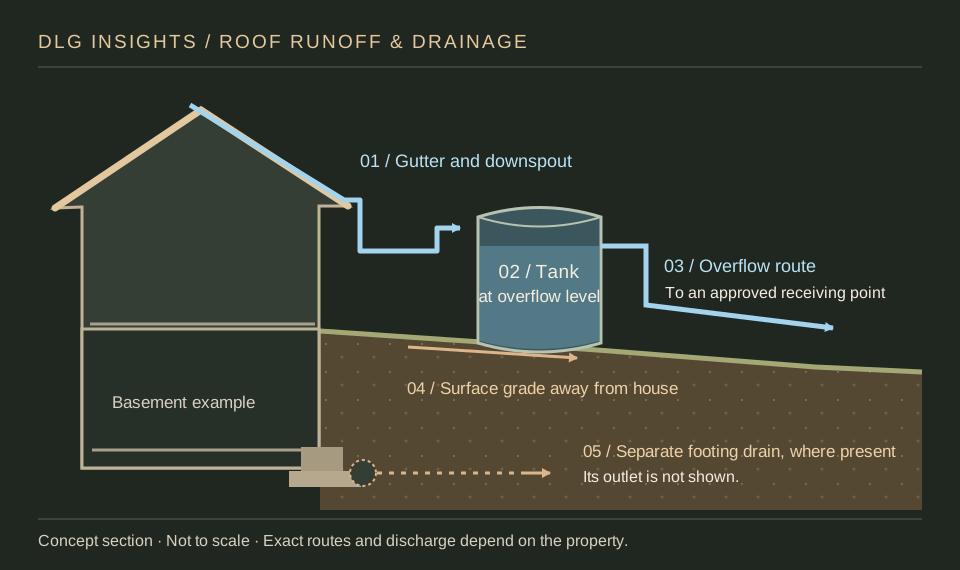
- Roof: Gutters collect roof runoff; the downspout carries it to the tank in this example.
- Tank: Water can enter until it reaches the overflow elevation. Available space depends on the starting water level.
- Overflow: Follow the outlet all the way to a receiving point suitable for the site and permitted locally.
- Surface grading: Look for a route that carries surface water away from the house rather than back toward it.
- Footing drain: Where present, it collects subsurface water around the foundation. Keep it separate from the roof runoff and tank overflow routes.
Find the outlet, then follow the hose.
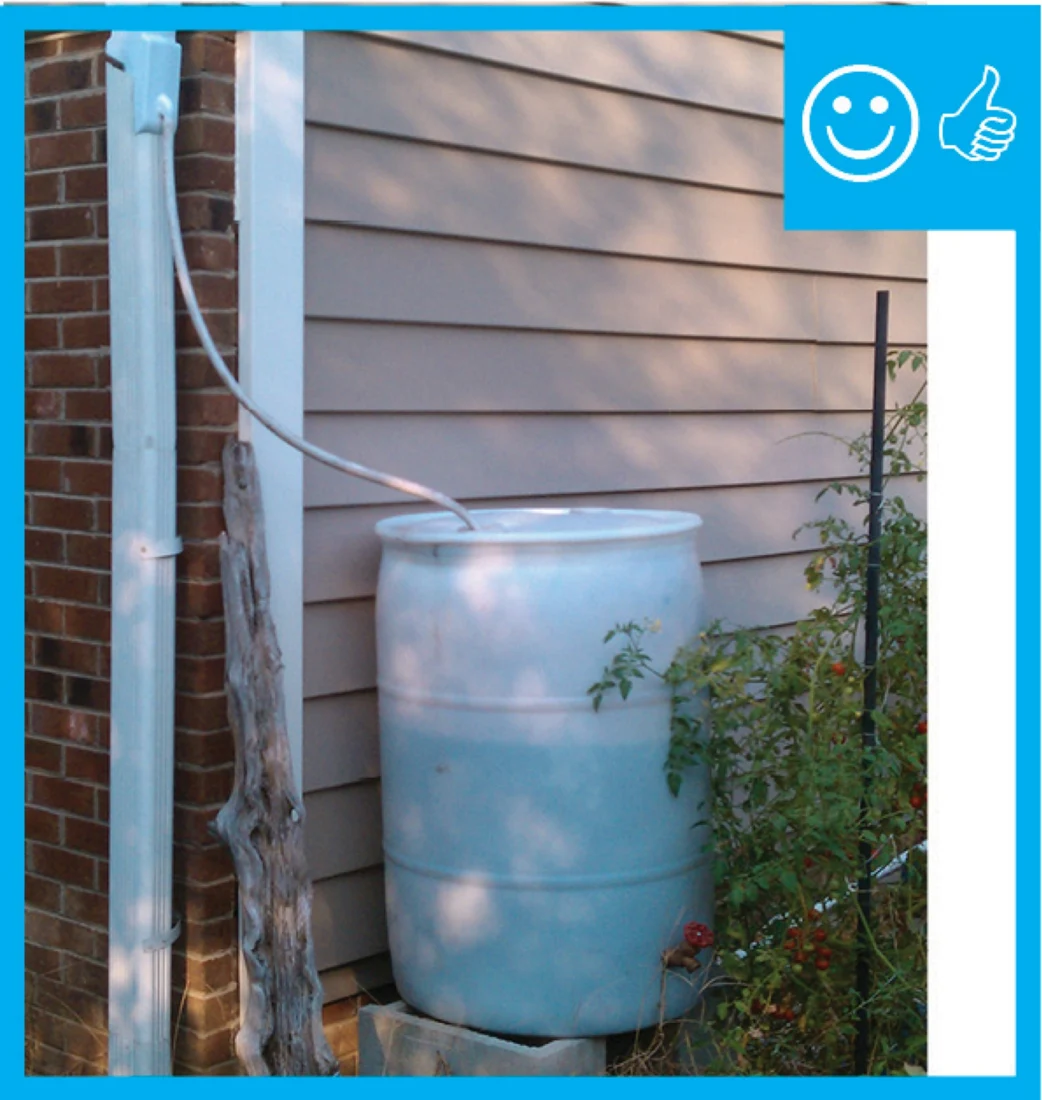
The photo shows a side outlet and a hose. In person, follow the hose beyond the frame. A visible outlet does not tell you whether the receiving point is appropriate, how the route performs in heavy rain, or whether it is allowed.
Ask: “Can you show me exactly where this discharges when the tank is full?”
Worked example / U.S. gallons
Tank size is not available space.
Suppose a 400-gallon tank already holds 250 gallons when a storm starts. If 500 gallons reach the tank during the storm and no water is drawn during that time:
- Available storage
- 400 − 250 = 150 gallons
- Water that overflows
- 500 − 150 = 350 gallons
This example assumes an unobstructed outlet and treats the tank capacity as the volume up to the overflow opening. It estimates overflow volume; pipe sizing also depends on how quickly runoff arrives. Estimate roof collection separately.
What to check at a home showing
- Trace both ends: Identify the inlet and overflow outlet. Ask to see the downstream outlet or request a drawing if the route is buried.
- Look at the ground: Note where the grade falls and where water appears to collect around the foundation, window wells, and walkways. These observations are prompts for follow-up, not a diagnosis.
- Separate the systems: Ask which line serves the roof or tank and which, if present, serves the foundation. Do not assume a buried pipe’s destination.
- Before changing a route: Verify the receiving point and applicable local requirements with the relevant authority and a qualified professional.
Next: read the landscape and drainage guide or review rainwater harvesting.
Sources and scope
The section and arithmetic are educational examples, not a drainage design or a statement of local code.