
DLG GROUP · INSIGHTS / LANDSCAPE & EXTERIOR
Aromatic planting: group by conditions
Group aromatic plants by their growing conditions and intended use. Check named plants, regional suitability, layout and maintenance responsibilities before assembling a planting palette.
01 / Purpose, named plants & place
An aromatic border can bring texture, fragrance and a useful seasonal rhythm to a garden. Start with the site and the intended use, then choose plants whose light, water and maintenance needs can work together.
This guide offers a candidate palette, a layout method and an explicitly assumed setting-out exercise. It is not an actual site planting schedule or a guarantee of overwintering at every address. The three regional lenses below are DLG planning interpretations of the identified Extension guidance, not results from three local garden trials.
1. Give the planting a clear job
Decide whether the priority is ornamental fragrance, a walk-edge planting, convenient culinary harvesting or a container group. These uses can overlap, but the plant identity and maintenance plan still need to be recorded.
Before buying plants, make a simple site note: direct sun in the intended season, shaded periods, soil texture and drainage, wind exposure, nearby paving, irrigation and available winter storage. Photograph the bed after rain as well as on a dry day. Separate what you observed from what remains to be tested.
Virginia Cooperative Extension emphasises plant origin, sun, soil and the management of spreading herbs. It also distinguishes moisture needs among herbs; a drought-tolerant label does not remove establishment or dry-period watering. [AP01] Use that framework to define manageable groups rather than scatter one of every aromatic plant through the same irrigation zone.
2. Compare named plants, not only common labels
The following candidates identify useful questions. They are not a prescription to buy every row. Confirm the botanical name, exact cultivar and actual nursery label; closely related plants can have different habits and uses.
| Candidate | Role to explore | Selection checkpoint |
|---|---|---|
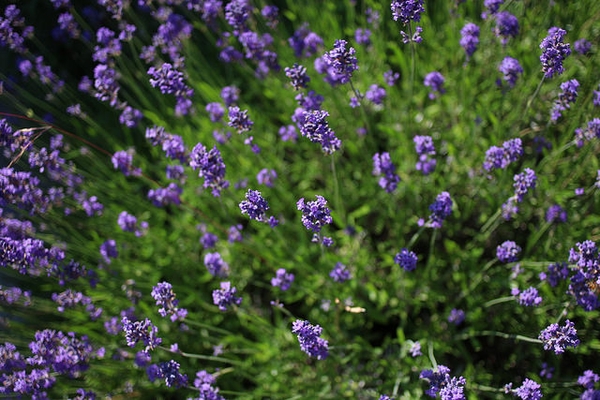
| English lavender — Lavandula angustifolia | Flowering, grey-green structural group | Sunny, freely drained position; exact cultivar and winter suitability [AP04] |
| Common thyme — Thymus vulgaris | Lower aromatic mound or managed border | Good drainage and sun; distinguish this species from a selected creeping thyme [AP06] |
| Culinary sage — Salvia officinalis | Textured foliage and a larger supporting mound | Allow the chosen form its mature space; verify drainage and exposure [AP07] |
| Rosemary — Salvia rosmarinus (also Rosmarinus officinalis) | Woody focal plant or movable container | Exact cultivar, upright/trailing form and winter strategy [AP08] |
| Spearmint — Mentha spicata | Separately managed fresh-green container group | More consistent moisture and active spread control [AP05] |
| Culinary oregano — Origanum vulgare selections | Repeated lower-to-medium group | Confirm culinary identity and how spreading growth will be managed [AP02] |
| Lemon balm — Melissa officinalis | A separately monitored candidate | UGA describes its ability to spread and crowd neighbours; retain space and a removal plan [AP02] |
NC State lists multiple rosemary cultivars, including ‘Arp’ and ‘Tuscan Blue’. A listed name is a starting point for a local supplier discussion, not proof that either will survive a particular Boston, NOVA or Atlanta winter. [AP08] Do not substitute an unlabelled ornamental “sage” or “oregano” for a culinary selection.
3. Adapt the palette to the regional question
Greater Boston: plan the cold-season change
Begin a candidate bed with locally confirmed thyme, culinary sage and oregano selections. Consider English lavender only after checking the exact cultivar and drainage. Keep rosemary as a separate movable-container or seasonal decision until its winter arrangement is resolved.
UMass’s official indexed growing tips describe gardeners taking rosemary indoors for winter; the full page returned an access restriction in this review. [AP03] UVM provides a separate New England example of container rosemary moved indoors before frost, but its Vermont account is not a Boston hardiness finding. [AP10]
For this planning lens, draw both the growing-season arrangement and the winter arrangement. Identify where containers go, how they remain accessible and what the border looks like when a seasonal focal plant is absent. Ask the local nursery or Extension adviser to confirm the chosen cultivar for the actual address.
Northern Virginia: divide the bed by needs
Use the Virginia Extension site-and-culture framework to evaluate a sunny, drained thyme/sage/oregano group. Assess lavender separately if soil or winter wetness is uncertain. Place mint in its own managed container area rather than give it the same watering assumption as a drier aromatic group. [AP01, AP04–07]
A useful NOVA sketch therefore records the bed, its water route and a separate container circuit. Rosemary remains an exact-cultivar and winter-exposure decision; “Virginia” is too broad to establish its performance at the site. This is a regional planning arrangement, not a county-approved species list.
Atlanta: review the summer conditions as well as winter
UGA’s Southern Gardens guide supports herb grouping by growth habit and cultivation needs, notes spread management, and identifies summer difficulties for some herbs in southern heat and humidity. [AP02] For an Atlanta proposal, review airflow, wet pockets and the watering regime before committing to a dense aromatic border.
Consider thyme, sage and oregano as candidates for the sunny, drained group; assess the selected lavender’s summer performance with a local supplier rather than assuming a Mediterranean appearance guarantees success. Rosemary can be explored as a separate structural candidate with its cultivar and winter conditions recorded. Mint remains a separately maintained moisture group.
The visual goal can be similar across the three regions, while the species, cultivar, container strategy and maintenance calendar differ. None of these lenses replaces a site-specific hardiness, soil or current local invasive-status check.
02 / Layout, containers & care
4. Make a calm, readable layout
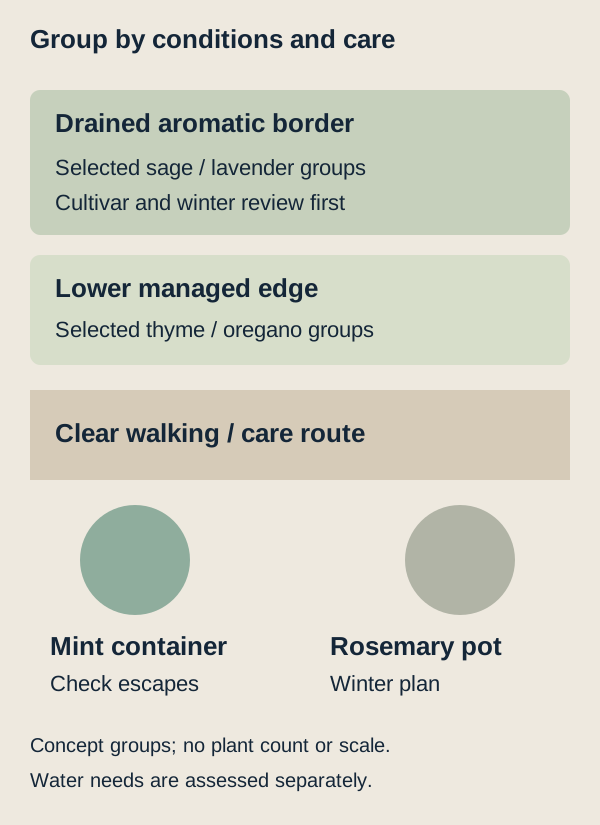
Use a small number of repeated groups and leave access to inspect, harvest and replace them. Set the spacing from the selected cultivar’s mature dimensions; the concept below provides neither a plant count nor measured distances.
| Position in the composition | Candidate arrangement | Decision before setting out |
|---|---|---|
| Back or focal position | Selected taller sage/lavender group where appropriate | Mature form, visibility, exposure and access |
| Lower front | A genuinely lower-growing thyme selection | Mature spread and setback from the route |
| Repeated middle group | Compatible oregano or other selected herb | Water compatibility, spread and seasonal appearance |
| Separate container position | Spearmint, with inspection access around it | Escaping stems, roots and drainage destination |
| Movable focal container | Selected rosemary where a winter move is planned | Weight, route, winter location and care responsibility |
NC State’s container guidance recommends combining plants with similar light, moisture and nutrient needs. [AP09] Apply that principle before choosing matching pots: one coordinated appearance does not require one irrigation routine.
5. Contain mint and manage the edges
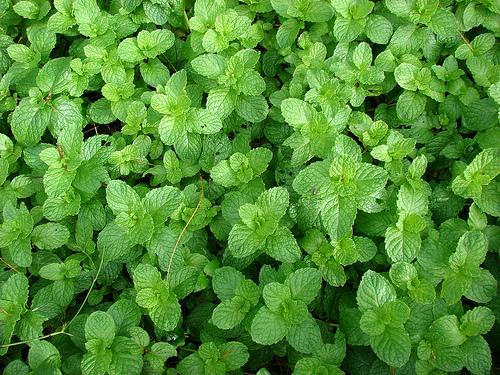
NC State describes spearmint spreading through rhizomes and stems that can root on contact with ground; it favours a moist, well-drained setting rather than dry soil. [AP05] A container is a management tool, not a promise that spread becomes impossible. Keep its perimeter visible and check escaping growth.
For the garden edge, show the path, finished soil, container support and water destination on the same sketch. Ask how the arrangement avoids obstructing drainage or gradually narrowing the route as plants mature. Raised beds and containers still need a resolved water exit; their appearance does not demonstrate good drainage.
Look closer: container, root space and water exit
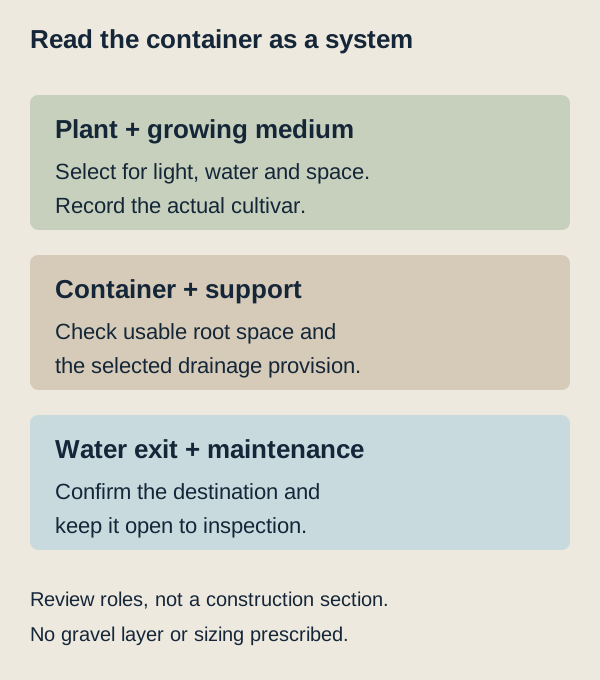
Keep a container record: plant/cultivar, container material and usable space, selected medium, drainage provision, location, watering check and winter action. A decorative outer pot needs its water behaviour understood as well. Record changes after the first season rather than treat the first arrangement as permanent.
6. Establish, observe and refine
- Confirm identity and conditions. Select the actual plants after the site and cultivar checks.
- Resolve the bed or container. Confirm soil/medium, water route, mature space and access before planting.
- Set the groups out. Check the view and walking clearance using the actual plant labels and sizes.
- Establish and monitor. Adjust watering to the selected plants, medium and observed conditions; do not assign one fixed weekly amount to every group.
- Review each season. Record growth, spreading, winter loss, maintenance effort and replacement choices.
Keep ornamental and culinary intentions explicit. Confirm identity and intended use before harvesting, and use an appropriate water source. The existing landscape guide’s illustrative roof-water system is limited to ornamental planting; this article does not approve that water for edible herbs.
An aromatic label is not a medicinal, mosquito-repellent or universally pet-safe claim. This guide makes no such promises. Its useful output is a clear plant-and-place record that can be refined with local horticultural advice.
03 / Measured example & proposal
7. Work through one measured layout before ordering
The following is an invented setting-out exercise, not an approved species schedule. Assume a level 4.00 × 1.80 m bed (7.20 m²) with a path outside its front boundary. The candidate composition has four lavender plants in the back row and eight common-thyme plants in front. Mint and movable rosemary remain in separate containers outside this bed and its watering group.
For the drawing only, assume mature canopy diameters of 0.80 m for the selected lavender and 0.35 m for the selected thyme. These numbers are editorial inputs, not published dimensions for an identified cultivar. NC State describes English lavender as requiring full sun and very good drainage, with a mounded form that can reach about three feet wide; this makes cultivar selection and mature spread important before retaining the illustrative 0.80 m envelope. [AP04] The exercise must change if the nursery’s actual plant information differs.
| Setting-out item | Assumed example dimension | Arithmetic / consequence |
|---|---|---|
| Back-row centres along the 4 m length | 0.65, 1.55, 2.45 and 3.35 m | Four plants at 0.90 m centres |
| Front-row centres | First at 0.425 m; then seven intervals of 0.45 m | Eight plants; last centre 3.575 m |
| Row positions measured from the front edge | Front 0.45 m; back 1.25 m | Rows 0.80 m apart |
| Assumed back canopy clearance | 0.90 − 0.80 m | 0.10 m between neighbouring envelopes |
| Assumed front canopy clearance | 0.45 − 0.35 m | 0.10 m between neighbouring envelopes |
| Back envelope to rear boundary | 1.80 − 1.25 − 0.40 m | 0.15 m in this geometry |
| Minimum bed order in this exercise | Four lavender + eight thyme | Twelve plants, not twelve species or a square-metre planting-density rule |
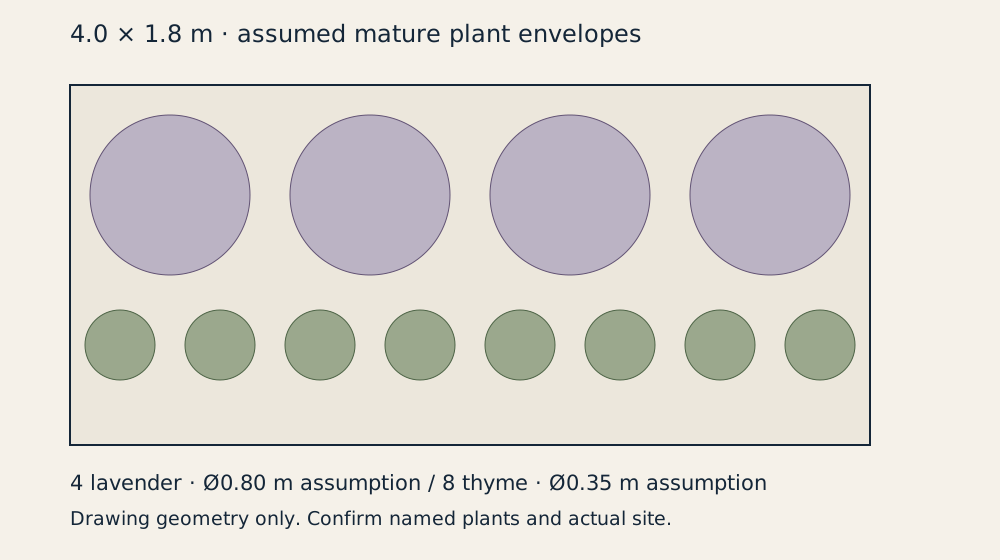
The 0.10 m gap is a geometric result, not an airflow standard. Irregular growth can close it. Do not retain this count simply because a supplier can deliver twelve pots: check cultivar, drainage, growth habit, maintenance access and the neighbouring path. For Boston, the rosemary container still needs the winter plan described earlier; for Atlanta, review summer wetness and circulation; NOVA still needs an actual soil/water assessment. The diagram is shared arithmetic, not three local planting trials.
Convert container dimensions into an ordering discussion
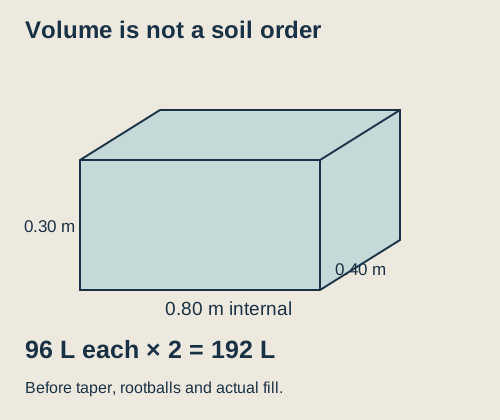
For two fictional rectangular containers with 0.80 × 0.40 m internal plan dimensions, assume a 0.30 m fill depth within a 0.35 m internal depth. Each fill envelope is 0.80 × 0.40 × 0.30 = 0.096 m³ = 96 L; two provide 192 L. The unused 0.05 m is an example’s headroom, not a universal planting requirement. Real tapered walls, inserts, root balls and an existing medium change the quantity of new material to order. Do not subtract a root ball and then add its old medium again as if both were empty space.
NC State’s container handbook advises against adding a bottom layer of gravel to improve drainage; it explains that water can remain in the growing medium above that interface. [AP09] Specify the actual container openings, compatible growing medium and receiving surface. An outer decorative pot must have its own water behaviour checked. Do not use gravel volume as an automatic deduction from the 192 L teaching envelope.
8. Make the landscaper’s proposal and handover comparable
| Proposal item | Evidence to request | An omission to resolve |
|---|---|---|
| Plant supply | Botanical name, cultivar, nursery size and agreed substitution process | A price for “lavender” without plant identity or mature form |
| Site preparation | Observed soil/drainage, defined preparation and disposal scope | An attractive bed drawing with no water-route assessment |
| Setting out | Dimensions, plant count, mature envelopes and path clearance | Counts derived only from planting area |
| Containers | Usable dimensions, medium, openings, support and maintenance access | Decorative appearance treated as proof of drainage |
| Watering | Establishment checks, separate moisture groups and responsible person | One fixed schedule for all herbs and containers |
| First-season review | Recorded condition, agreed replacement terms and adjustment visit | An undefined promise that plants are “guaranteed” |
Handover should identify what was planted and where, the actual medium/water route, who checks establishment and winter moves, and how replacements or spread are handled. Compare prices only after the plant identities, sizes, preparation and maintenance scope match. A lower plant-only total is not equivalent to a planted-and-established proposal.
Keep culinary use and water quality visible in this handover. The separate rainwater module remains an ornamental-use example; this planting layout does not approve roof-collected water for edible herbs. Record an appropriate water supply for the intended use rather than connecting the two modules merely because both involve gardening.
Sources, assumptions and review dates
Sources and scope
Checked 20 October 2026. These primary Extension references support the named plant traits and planning questions; they are not three local performance trials. No generic spacing, yield or survival guarantee is supplied.
- AP01 — Virginia Cooperative Extension: Herb Culture and Use. Site, culture, plant origin and spread management.
- AP02 — UGA Extension: Herbs in Southern Gardens. Southern growing context, habits and candidate identities; not transferred as Boston requirements.
- AP03 — UMass Extension: Easy Herbs: Growing Tips. Narrow official indexed winter-rosemary statement only; full-page retrieval returned 403.
- AP04 — NC State: English lavender. Species, drainage and photograph attribution; not a confirmed local cultivar.
- AP05 — NC State: Spearmint. Moisture, rooting/spread, management and photograph attribution.
- AP06 — NC State: Common thyme. Species, sun/drainage and growth form.
- AP07 — NC State: Culinary sage. Identity, exposure and drainage.
- AP08 — NC State: Rosemary. Botanical name, growth forms and listed cultivars; not regional survival evidence.
- AP09 — NC State: Plants Grown in Containers. Compatible light, water and nutrient requirements.
- AP10 — University of Vermont: Fresh Rosemary for Every Season. Dated New England container example, not Boston field-trial evidence.
Selected depth review, 20 October 2026: AP04/AP06/AP09 revisited for plant form, drainage and container principles. The numerical plan and container dimensions are editorial assumptions, not nursery specifications. Other sources retain their original review/retrieval limits. Existing licensed plant photographs are unchanged; the new plan is an original DLG drawing.