Start with the intended use. Establish what can be built, what approvals are needed and what it will cost before treating a land price as a project budget.
Official sources reviewed November 20, 2026. First-release educational overview: Greater Boston, Northern Virginia and Metro Atlanta. Local examples are not state-wide rules or parcel-specific approval.
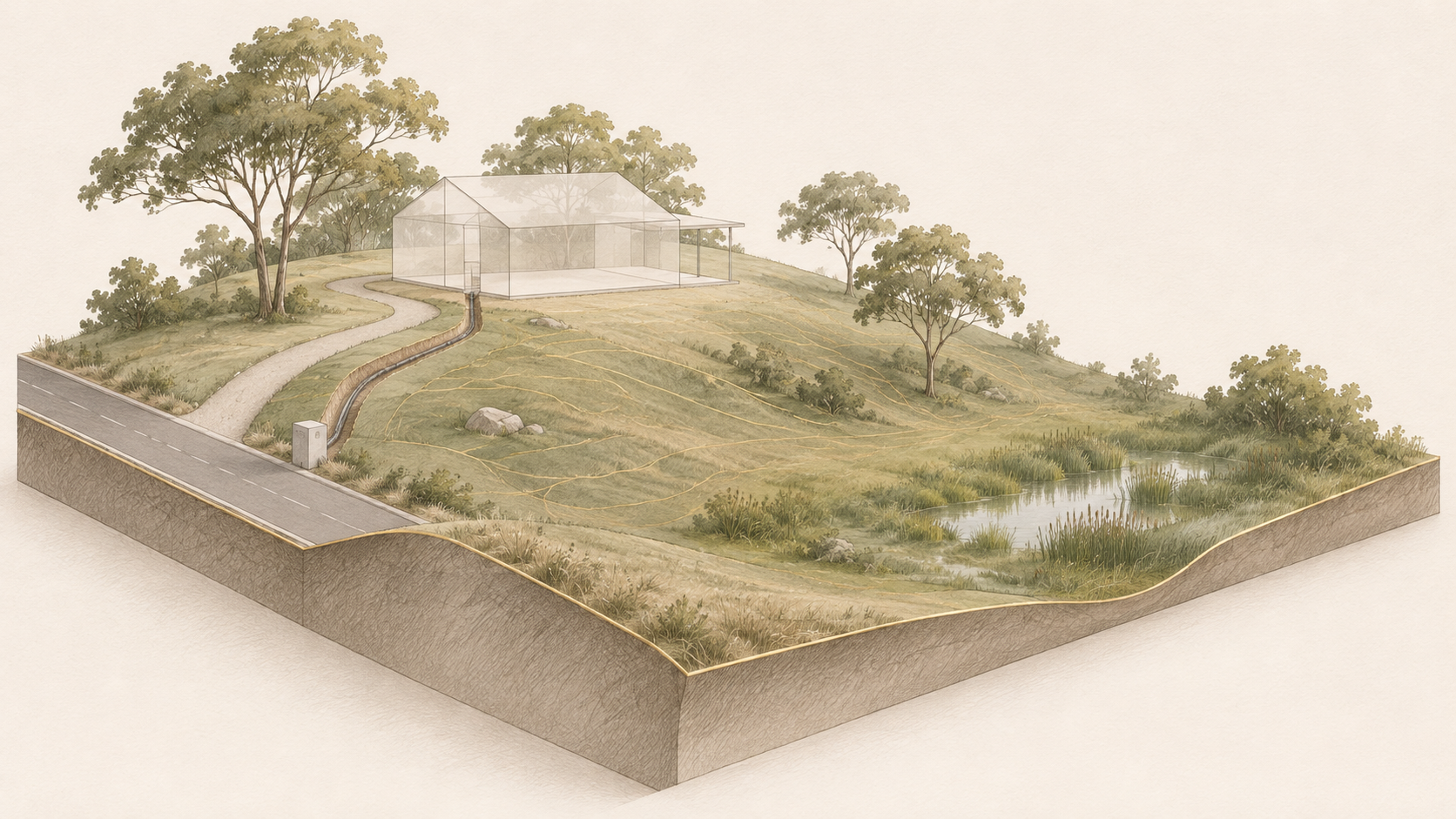
AI-generated conceptual illustration for DLG. Not a real parcel, listing, surveyed boundary or approved design. The positions of the road, utilities, wet area and house are illustrative; actual feasibility requires property-specific investigation.
Access: establish legal rights and road requirements.
Services: verify connection routes and capacity.
Terrain and water: investigate soils, drainage and protected areas.
Building concept: test the design against local permissions.
Before buying: define the project and test the site
Purpose: holding land, a home for personal use, rental development, subdivision or agricultural use require different checks. Write down the proposed use and scale.
Title, boundaries and access: obtain the title review and appropriate survey; investigate liens, restrictions, easements and legal road access. A visible track is not proof of access rights.
Land-use permission: confirm zoning, allowed uses, setbacks, density, lot status and overlays with the responsible locality. Ask what requires discretionary approval rather than assuming rezoning or subdivision will be granted.
Physical feasibility: ask the relevant professionals about topography, soils, drainage, floodplain, wetlands, environmental history and the space needed for the intended development.
Utilities: obtain written availability and connection requirements for water, wastewater, power and access improvements. Where relevant, investigate well and septic feasibility before relying on a house layout.
Contract protection: have local counsel review due-diligence access, investigation deadlines, deposit treatment and any permit/financing conditions before signing.
Record each unresolved item as unknown. A legal parcel is not automatically a buildable parcel. Fairfax County expressly distinguishes these questions.
Request the actual parcel assessment, classification, applicable local levies, outstanding balances and any special tax-use program. Do not copy a homeowner exemption or a house's effective tax rate onto vacant land.
Ask the assessor and your tax adviser what a sale, subdivision, rezoning, new construction or change of use could do to the assessment and any deferred tax. Reduced-use assessments may carry conditions and later tax consequences. Check the specific program and proposed transaction; this guide does not calculate eligibility, rollback tax or a tax saving.
Budget annual property tax separately from survey/legal fees, insurance, maintenance, association or road charges where applicable, and financing/holding costs. Obtain the current local figures rather than using a state-wide percentage.
Request actual lender terms for the parcel, intended use, borrower and ownership structure. Compare land/acquisition funding, construction funding and the permanent financing or sale plan separately; one approval does not establish the others.
Ask about required equity, loan-to-value or loan-to-cost limits, valuation and treatment of land already owned.
For construction, ask about approved plans, builder requirements, draw inspections, interest on advances, fees and contingency requirements.
Confirm maturity, extensions and the exit if the project is delayed. CFPB notes that construction balances may need repayment or conversion; a new loan application may be needed if conversion is not automatic.
For a foreign buyer, request eligibility and documentation requirements directly. Do not assume a fixed down payment, rate premium or access to a program.
The existing home mortgage calculator models a completed-home loan. It does not model construction draws, land-loan terms or development finance.
Three regional research routes
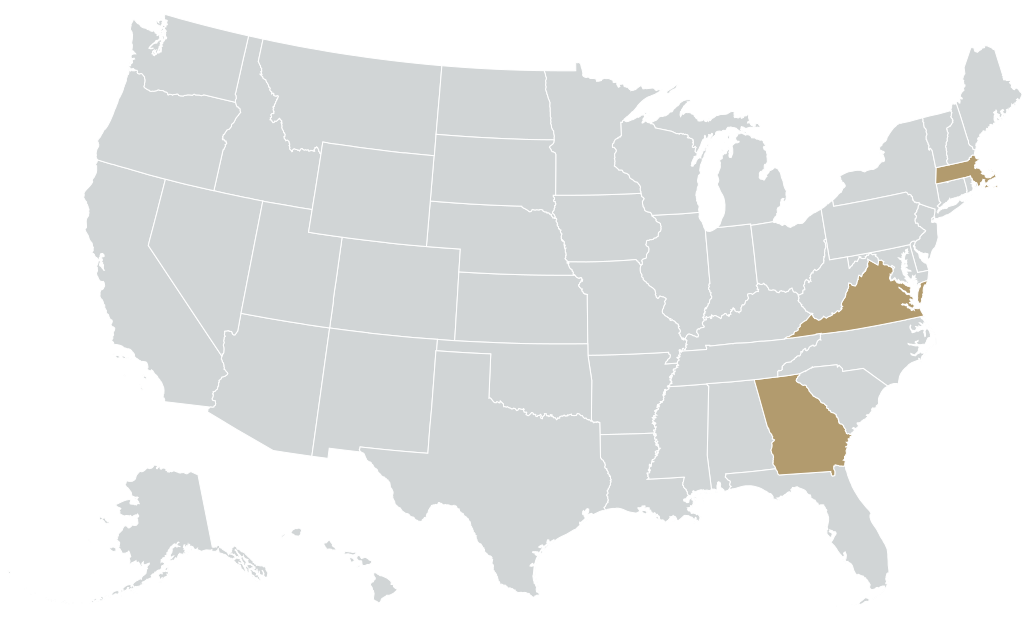
Gold marks DLG's three focus states: Massachusetts, Virginia and Georgia. The detailed routes concern Greater Boston, Northern Virginia and Metro Atlanta, not every parcel in each state. Census-derived boundaries via us-atlas v3, ISC license; Albers USA projection with Alaska/Hawaii insets.
GREATER BOSTON / MASSACHUSETTS
Begin with the municipality
Identify the local zoning/building authority; Boston and surrounding towns are different jurisdictions.
Ask the Conservation Commission about wetlands and local requirements before clearing, grading or fixing the building footprint.
If not sewer-connected, investigate septic design and local Board of Health requirements under the applicable Title 5 process.
Request tax classification and any program/land-use restrictions for the actual parcel.
FeasibilityRights and siteAccess, use, soils, utilities
ConceptDesign and budgetScope, layout, initial estimates
ReviewApprovals and plansLocal land, site and building checks
CommitmentFinance and contractLender and builder requirements
DeliveryBuild and inspectDocument work and changes
CompletionApprove intended useFinal conditions and occupancy
A planning sequence, not a universal permit order:
Site and legal feasibility; initial professional and authority discussions.
Survey, concept design and site/utility strategy; reconcile the scope and budget.
Required land-use, environmental and site approvals; detailed architectural and engineering documents.
Financing, builder selection and written contracts aligned with permit conditions.
Applicable permits, construction inspections, documented draws and change orders.
Required final approvals and occupancy authorization, where applicable, before the intended use.
Some reviews overlap and others are prerequisites. Ask each authority and lender for the sequence, submission requirements and current process. No fixed approval time or construction price is promised.
Build a land-plus-development budget
Land price + acquisition costs + investigations + design/approvals + infrastructure/site work + construction + financing/holding + contingency. Record the estimate source, date, scope, exclusions, payer and payment stage. Keep a reserve distinct from confirmed spending; count each item once.
The downloadable blank template records quotes and evidence alongside the calculator below. This is not an automated feasibility model. Unknown amounts stay blank. Tax, credit pricing and construction estimates must come from the appropriate adviser or provider.
Land development budget calculator
Enter your own amounts in USD. Blank means unknown; enter 0 only when you intentionally allow zero. One-time costs and monthly holding costs are separate. The same item belongs in one place only.
No entries are sent to DLG or saved automatically. Download your working CSV before leaving. The export contains entered estimates, not the separate evidence and quote notes from the blank worksheet.
Use the period you intend to model. Monthly interest is your own planning allowance; construction loan draws, changing balances, taxes after development and detailed cash timing are not modeled. Do not add loan principal as a project expense or a financing fee. Reserves are retained allocations, not assumed spending. This is not a profit, return, affordability or lender-approval calculation.
Additional checks for overseas buyers
Before acquiring land, have counsel check buyer eligibility and applicable foreign-ownership, agricultural-land reporting and other restrictions for the particular owner, location and use. The international homebuying overview is not farmland or development clearance.
Design · Land · Growth
Design connects the intended use to a project. Land supplies the location, rights and physical constraints. Growth asks whether the completed plan is supportable over time. DLG brings these questions together as educational research; it does not offer project approvals, lending commitments or brokerage representation.